Home » Your chain » Junction 3: Planning & implementation
'Planning & implementation' Data quality affects the efficiency of scheduling and executing tasks and projects.
At the ‘Power up your SAP chain’ event, you’ll discover how successful organisations are strengthening their SAP chain with reliable data, smart processes and integrated systems.
Let customer support work planning &implementation become better coordinated
The customer explained the problem in detail when reporting the fault, but subsequently felt frustrated because the engineer was not properly informed and did not have the correct materials with him. Because processes do not link up properly, you have to constantly make adjustments to meet commitments. By ensuring that service processes are better aligned and supported with the right information, you create greater coherence and, consequently, greater peace of mind in your operations.
An issue thataffects the entire supply chain
Service does not stand alone. How well the operation functions depends on data, maintenance and strategy.
This issue affects the entire Service & Asset Management chain:
Data & integration Without a solid data foundation, you lack reliable insight into your asset performance. Show critical junction 1
Maintenance & predictability Maintenance remains reactive without reliable data. Show junction 2
Strategy & lifecycle Without a clear understanding of performance, you cannot make informed decisions about the lifespan of assets and investment choices. Show junction 4
You have limited insight into how assets perform in practice. Information from service operations is not always passed on or is reported incorrectly. If the schedule is not met, you carry out maintenance too late and everything gets pushed back.
As a Service Manager
You are dealing with dissatisfied customers and staff. Customers feel they are not being listened to, customer service staff are fielding angry calls from customers, and technicians are being sent out with incorrect information.
As an IT Manager
You are supporting multiple systems that are not properly integrated. Users have to switch unnecessarily between different applications, and information is not always available when it is needed.
From individual activities to aoperational service chain
In practice, we see that organisations which organise their service process as a whole make all the difference. As Erik van de Ven – Practice Lead, Service Portfolio – puts it:
“In many organisations, service processes are fragmented. Customer reports, work orders or asset information are often scattered across different systems or departments. As a result, information gets lost or is not available in time, meaning issues cannot be resolved at the first attempt, leading to frustration and missed (upsell) opportunities.”
A single digital chain
“The key lies in how systems, data and processes are interconnected. By linking these steps to form a coherent digital chain, you create a central source of information where everything comes together. Your customer interactions, work planning and execution are better aligned, meaning that valuable information is no longer lost.”
Improvements for planners and technicians
“As valuable information is no longer lost, you can plan more reliably. Because you have a better understanding of the nature of the work and can prepare for it more effectively, you don’t have to make last-minute adjustments, and lead times are reduced. You can see the benefits in the field too. By working remotely, technicians always have access to information such as task descriptions, forms, manuals and asset history, even offline. This increases the likelihood of carrying out work correctly first time and reduces the administrative burden afterwards. In more complex situations, remote support can be deployed if necessary. Thanks to digital instructions and remote support, knowledge can be applied immediately without the need for additional visits or waiting times.
Would you like to explore this in more detail? At the ‘Power up your SAP chain’ event, you’ll discover what the new capacity planning functionality in SAP FSA can do for your organisation.
Find out where your chain is getting stuck and how you can feel more empowered
IT as the foundation of Service & Asset Management
Beneath these nodes lies the IT landscape that connects everything. Following an S/4HANA transition, many organisations struggle with challenges such as making the standard user-friendly, for example through (Fiori) app development and extensions. Furthermore, flexibility often proves difficult to achieve: a cluttered core makes systems less manageable and limits upgradeability. Systems also frequently fail to integrate sufficiently with one another, slowing down processes and making it increasingly difficult to implement changes.
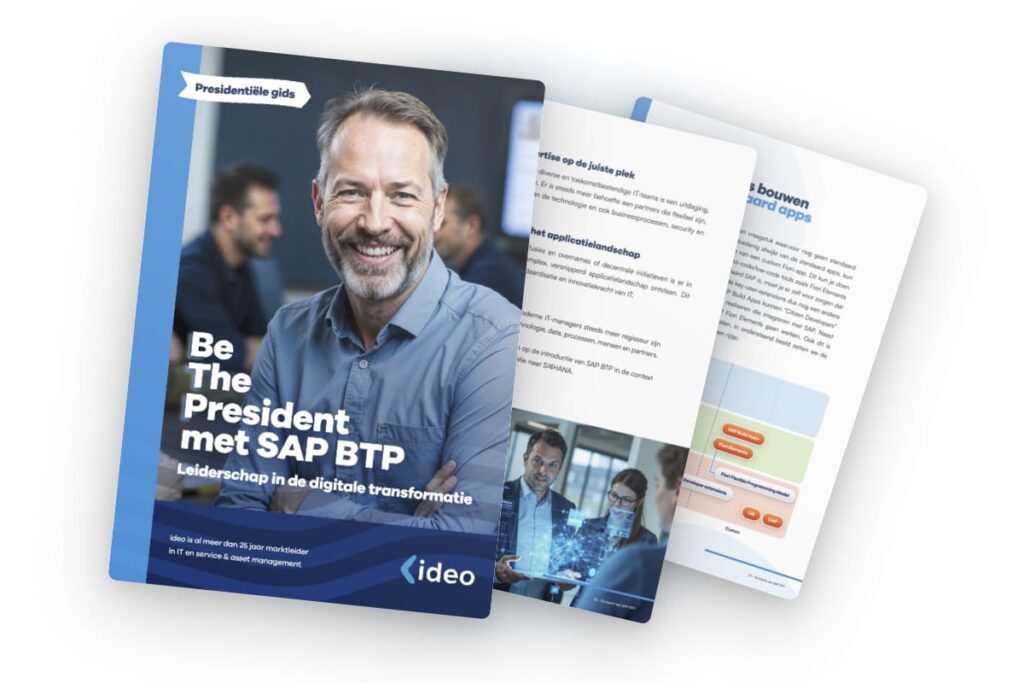
This white paper demonstrates how organisations can make the transition from a fragmented system landscape to a robust IT foundation for the supply chain. It focuses on how to achieve coherence between process, data and technology within Service & Asset Management, with platforms such as SAP BTP playing a key role.
Many organisations struggle with service processes that have become fragmented over the years. Your process steps do not link up properly, and information is not always available when it is needed.
We help to restore that coherence. Often, both service and maintenance orders form part of the planning and execution process. We have in-depth knowledge of service and maintenance processes and process steps such as the 9-phase model. By utilising SAP solutions, we ensure that customer contact, planning and execution are aligned and work together as a whole once again. This creates an efficient service operation that is predictable and scalable.
View our products and areas of expertise:
Discover the SAP solutions available at this junction:
Watch the webinar on junction 3Planning & implementation | From disparate service processes to a predictable and efficient operation
Register for the ‘Power up your SAP chain’ event
From disjointed links to a robust SAP chain. Be inspired by real-life stories from organisations such as the Ministry of Defence, Twence and Croonwolter&dros, and discover how to create greater cohesion between processes, data and systems.